Take a Look Behind the Scenes!
How many orangutans do you have?
- Indra (born Sept 7, 1980) came from Busch Gardens Zoo in Florida in 2025
- Mukah (born July 5, 1987) came from Henry Villas Zoo in Wisconsin in 2009
- Kerajaan (KJ) (born Aug 11, 1988) came from Gulf Breeze Zoo in Florida in 2009
- Kutai (born July 27, 1993) came from Toledo Zoo in Ohio in 2015
- Mei (born May 1, 1998) came from Brookfield Zoo in Illinois in 2009
- Razak (born Jan 12, 2017) was born here at Cameron Park Zoo
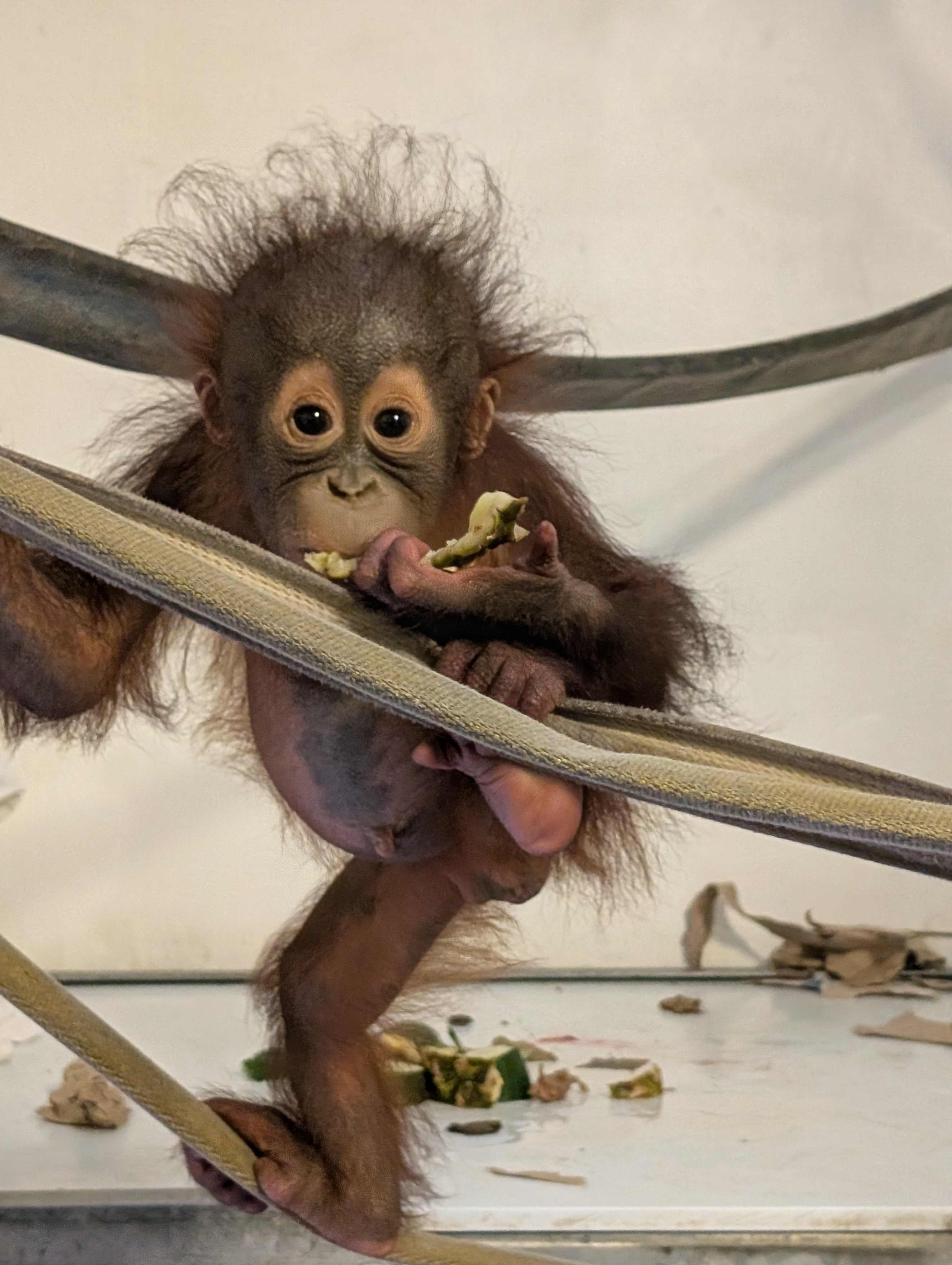
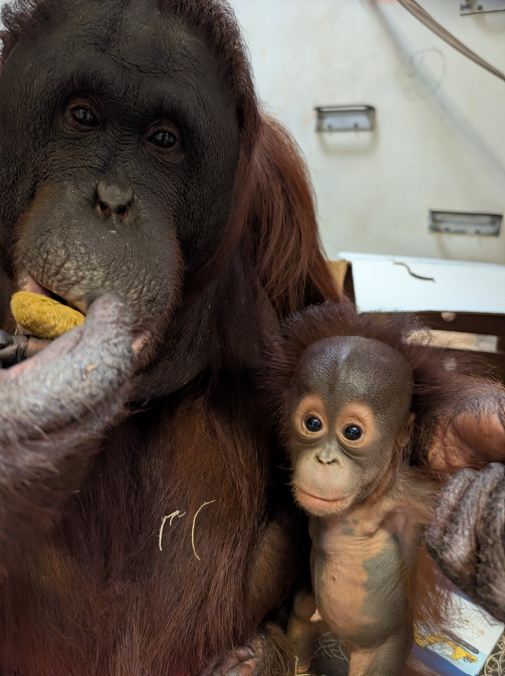
- Ravi (born Jan 1, 2026) was born here at Cameron Park Zoo
Why aren’t all the orangutans out at the same time?
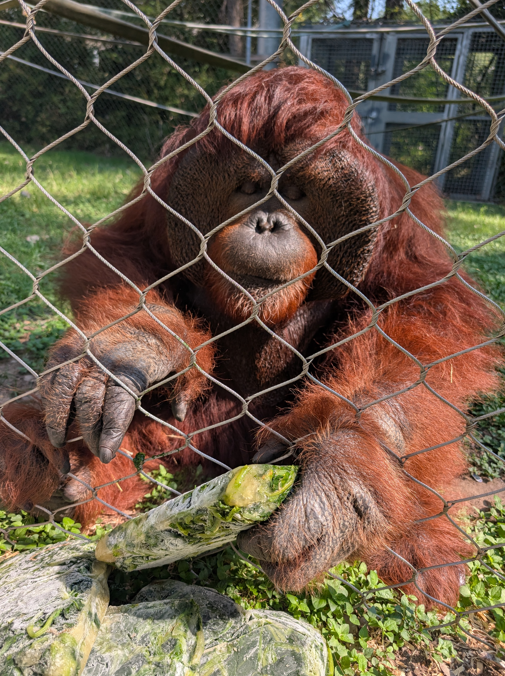
Orangutans are a really unique great ape and differ from chimps, gorillas and bonobos, in the fact that they are semi-solitary. This means that they will only spend time around each other in their natural habitat during breeding or high fruiting times where resources don’t need to be fought over. Predominantly one male will reign over multiple female territories and defend that space from other males.
Females will stay close to related females but still maintain their own territories. In managed care, we are able to increase their social groups because there is no restriction of resources – they have daily diet items and enrichment treats, they have no predators, their groups are heavily monitored for any discrepancies in the group and our animal care staff are experts in reading their behavior and providing them top of the line care any time; day, night, holiday, weekend.
Our animal care teams thoroughly discuss, research, and consult on introductions between the orangutans. They take many factors into consideration including the orangutan’s history, personalities, their previous groupings here or at other zoos, the age and life stage of them, hormones, comfort with the facility and team, dominant/subordinate relationships, and so much more.
These introductions have allowed Cameron Park Zoo to utilize a cutting-edge management strategy called “Flexible Housing”. This allows the orangutans to travel between groupings and have choice in their conspecifics (other orangutans). With our orangutans we can have between 4 to 6 groups. The groups daily are rotated through our habitat, bedrooms in the night house, and day yards. Several of these locations are behind the scenes and not visible to guests.
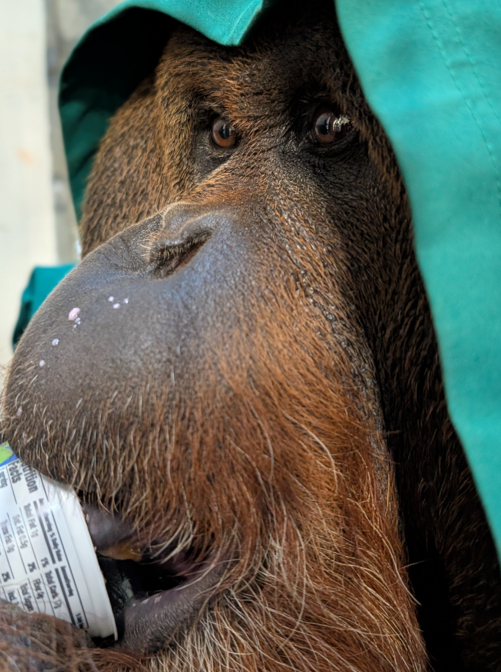
Why is an orangutan inside?
We manage the orangutans in a cutting-edge management strategy called “Flexible Housing” which allows the orangutan groups to change. The groups can be on habitat, in the bedrooms in the night house, and in the day yards – several of these locations are behind the scenes and not visible to guests, except for bedroom #5.
The orangutan’s favorite bedroom is #5. They love looking at guests, and the other orangutans on habitat. When the orangutans are inside animal care staff can provide unique enrichment, advanced training, and dynamic environmental changes that they cannot do on habitat, additionally the building is always 72 degrees, so it is a nice temperature if it’s cool or hot out.
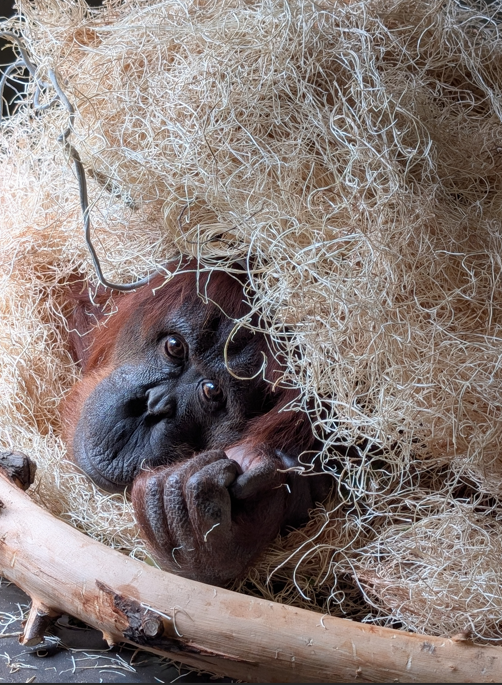
The orangutans rotate daily through the spaces, so if they are inside today, they were outside yesterday and will be out tomorrow. Having the days behind the scenes has always been one that orangutans’ behavior shows they enjoy – they get additional social time with the zookeepers, can have a movie or music on, watch a disco ball, can build more elaborate nests, get treats from puzzle feeders, etc.
Why do they look “sad”?
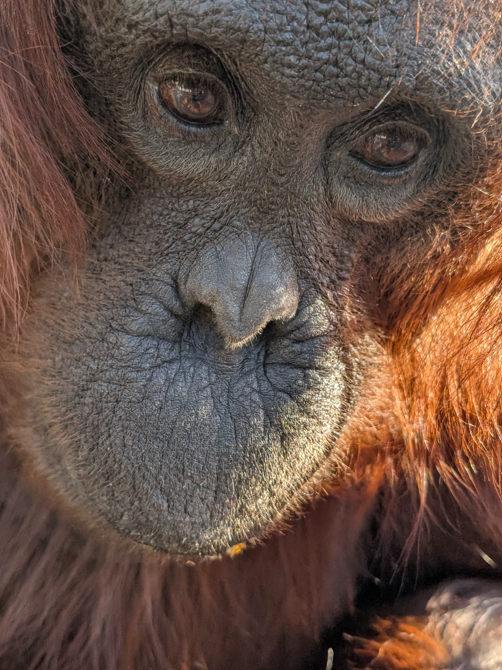
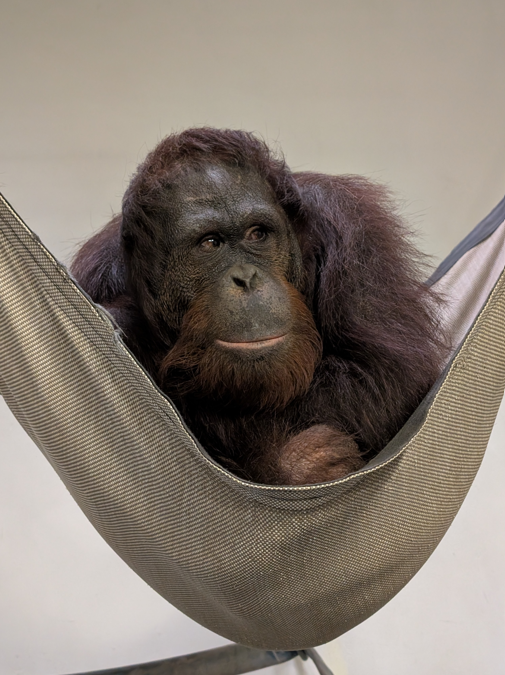
Guests can interpret the orangutan’s face as “sad” because they do not have the same facial expression meanings that humans have. As humans we quickly learned that a smile means joy and a frown is anger, but those are things that make us uniquely human and differ from the other great apes. For an orangutan, a “smile” is actually a fear grimace, that orangutans do when they are in a very fearful, stressful situation. And their long, stoic face could be the epitome of contentment. For our animal care staff they are experts at understanding orangutan behavior, so they have to look deeper than the orangutan’s facial expressions into their behaviors – How is their food consumption? Their fecal quality? Do they engage in social behaviors with zookeepers or other orangutans? Do they appropriately groom their hair? Do they engage with enrichment? Are they interested or successful with breeding? What vocalizations are they making and what do they mean (there are at least 32 vocalizations all with their own unique meanings)?
As humans, we will engage in anthropomorphizing very easily, this is adding human emotions or features to an inanimate object or something that isn’t human. Common examples are the Easter Bunny, talking about your plants being sad, or saying your computer doesn’t want to work with you. Anthropomorphizing is a fantastic way to engage with our environment, learn as children, and to connect with other people. When it comes to animal behavior, anthropomorphizing can create inferences to animals that don’t always take their natural history and behavior into consideration. For us, we are social creatures, we want to be around other people, so we may see an animal by itself and add the emotion of loneliness to them – when through their natural behaviors being with another individual could cause stress, fear response, or injuries if it isn’t prime breeding time or they’re territorial.
Orangutans, like all of our animals here at Cameron Park Zoo, have a wide range of behaviors and feel many different things, so during your visit take a look at their behavior and see what that may equate to. That sleeping lion isn’t bored, they’re getting their biologically needed 20 hours of sleep. That orangutan looking at you with their long face isn’t sad, they’re investigating and exploring their environment.
What days are certain orangutans out on habitat?
Ravi and her mom, Mei, are out every Saturday, and the other orangutans go out on a random rotation. When the orangutans are not on habitat, they are in our behind-the-scenes bedrooms or day yards.
The animal care staff always allows the orangutans to have choice and control on where they want to be. Every shift the orangutans are asked to move from space A to space B, but there are always days when they want to stay in space A. This allows them to make decisions about where or who they want to spend their time with and encourages our orangutans and animal care team to be flexible and adaptable to any situation that comes up. Sometimes this will mean that a well-made plan goes out the window, but the behavioral needs of the orangutans are more important.